
Night sky
constellations.
Ancient humans looked at random stars and saw hunters, bears, queens, and scorpions. Explore our curated field guide to the night sky's most famous and recognizable star patterns.
View to know.
Measuring distances
Hold your hand at arm's length against the night sky.
Let your eyes adjust
It takes your eyes about 20-30 minutes to fully adapt to the dark. Avoid looking at your phone or use a red light filter when checking star maps to preserve your night vision and see fainter stars in these constellations.
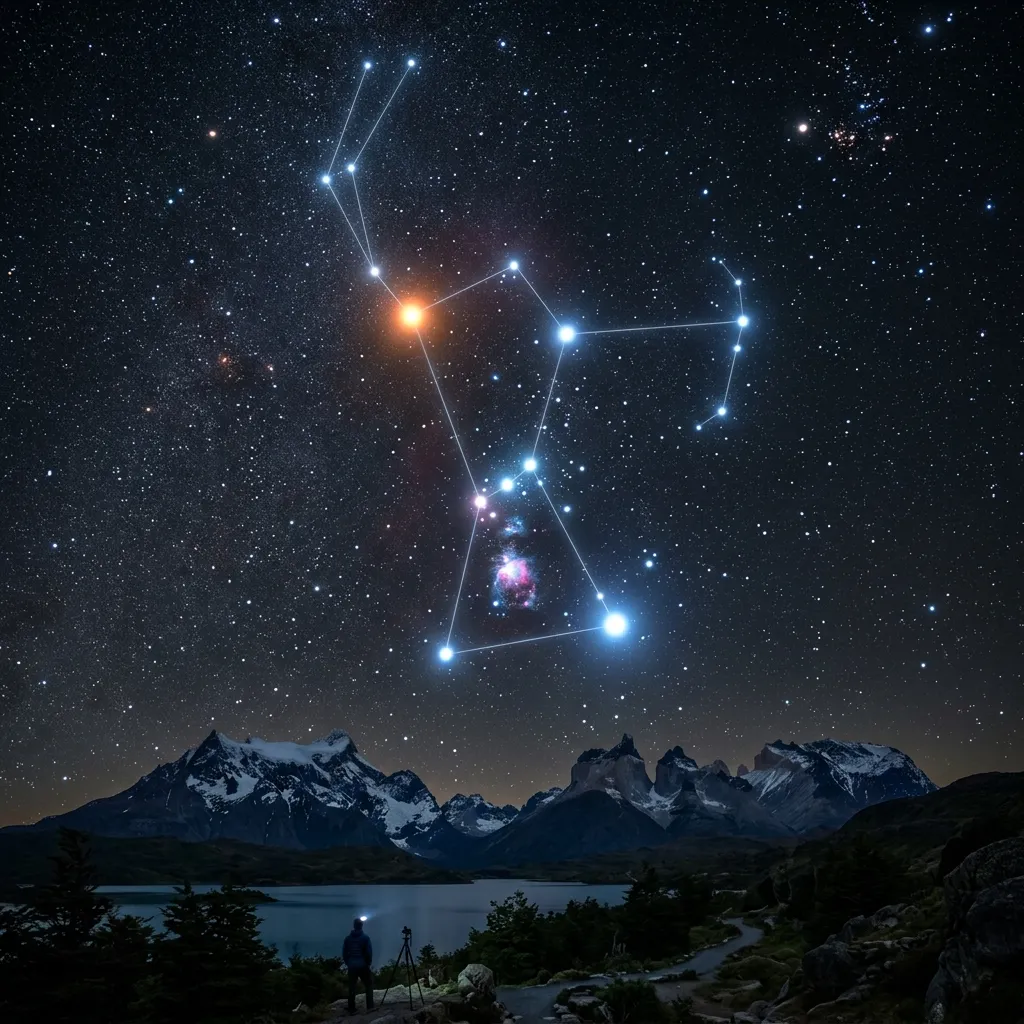
Orion
The Hunter
Look south on winter evenings for the three bright, evenly spaced stars of Orion's Belt. Betelgeuse (red) marks his shoulder; Rigel (blue) marks his foot.
A giant huntsman placed in the sky by Zeus. Pursued the Pleiades sisters and was ultimately killed by a scorpion — hence Orion and Scorpius sit on opposite sides of the sky, never visible together.
A constellation isn't a group of stars.
Since 1930, the International Astronomical Union has defined constellations as regions of the sky, not just star patterns. Every point on the celestial sphere belongs to exactly one of the 88 constellations — the "shape" is just the historically famous asterism inside that region.
An informal star pattern. The Big Dipper is an asterism inside the constellation Ursa Major, not a constellation itself.
The 12 constellations that lie along the ecliptic — the Sun's apparent path through the sky. (Actually 13 if you count Ophiuchus.)
Constellations that never set from a given latitude. From mid-northern latitudes, Ursa Major and Cassiopeia rotate around Polaris all night, every night.